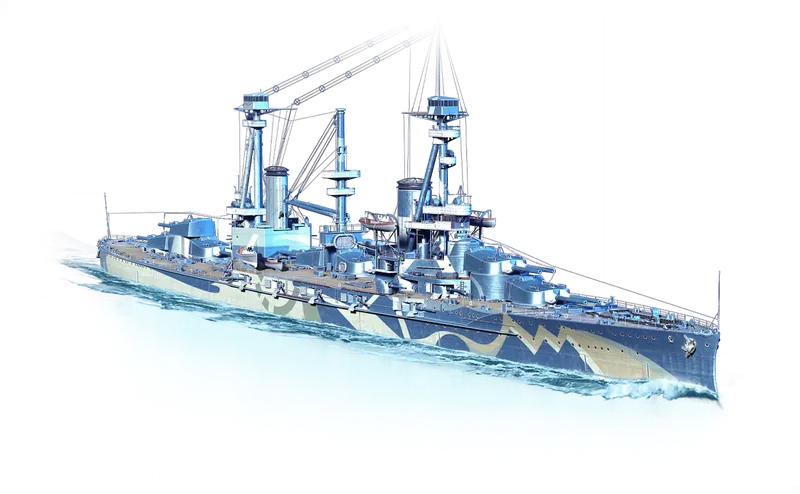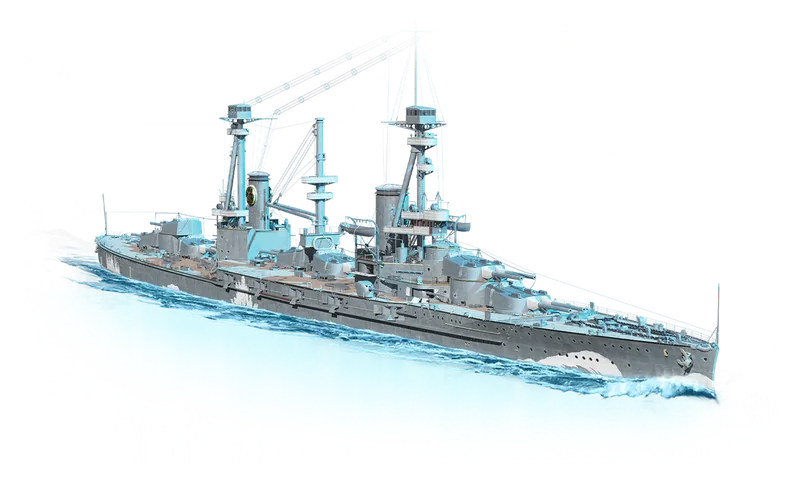


Survivability
Hit Points43,500
Displacement31,860 t
Hull dimensions 204.7 x 27.1 m (published figure)
ƒ
Length x beam at the waterline, with the hull's draft where the client carries one. Ships whose client entry holds only the 260 x 20 m placeholder use a curated real-world figure instead, and any ship we have no trustworthy size for omits this row rather than print the placeholder. Length matters when dodging torpedoes; beam and draft shape how hard the ship is to hit.Armor range13–305 mm
Plate armor thicknesses13, 19, 25, 30, 38, 64, 76, 102, 152, 229, 305 mm
Armor material/layer entries84
Fire resistance 10%
ƒ
Does not reduce the damage a burning fire does per second: replay-measured burn ticks run at the full rate on every ship. By elimination it lowers how often hits set you on fire; ignition-rate replay data is consistent with that but too confounded by attacker mix to measure the reduction directly.Fire duration60 s
Fire damage 0.3% of HP per second
ƒ
Each fire ticks 0.3% of max HP per second for the full 60 s, so one unattended fire burns 18% of the pool (7,830 HP on this ship). 4 fire points can burn at once. Verified against measured burn ticks in replay data.Flood duration40 s
Flood damage 0.5% of HP per second
ƒ
A flood ticks 0.5% of max HP per second for the 40 s duration, so one unattended flood costs 20% of the pool (8,700 HP on this ship). Verified against measured flood ticks in replay data.Torp Reduction 14%
ƒ
Reduces torpedo hit damage. Replay data shows no effect on floods: flood ticks run at the full rate and flood frequency does not decline with protection.Magazine HP 21,700
ƒ
Per-turret powder-magazine HP, a separate pool from the ship's. Penetrating hits wear it down and the turret is likelier to be knocked out as it falls, so a larger pool keeps the guns firing through punishment that silences a peer's.Steering gear HP 13,000
ƒ
Durability of the steering gears. As this pool drops, hits are likelier to jam the rudder; unlike most modules the steering can be knocked out and repaired but is never permanently destroyed.Effective HP 48,333–61,770
ƒ
Base 43,500 HP plus everything Repair Party can restore: 0.5%/s x 28 s = 6,090 HP per charge, x3 charges = 18,270 HP. Ceiling, not a prediction: a charge only restores damage actually taken, and only the regeneratable share of it. Across 1,826 players in our replay corpus the median ship realized about half of this, mostly because half the charges go unspent, and when Repair Party IS pressed it returns ~97% of the per-charge figure above.Repairable: penetration50%
Repairable: citadel10%
Repairable: steering gear50%

 Damage Control Party
 Repair Party
 Secondary Battery Booster