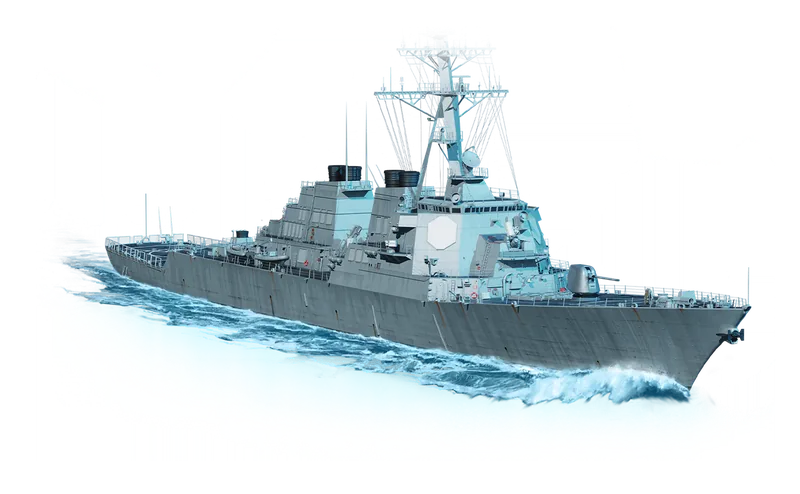
Hit Points54,000
Displacement9,000 t
Hull dimensions ƒ
Length x beam at the waterline, with the hull's draft where the client carries one. Ships whose client entry holds only the 260 x 20 m placeholder use a curated real-world figure instead, and any ship we have no trustworthy size for omits this row rather than print the placeholder. Length matters when dodging torpedoes; beam and draft shape how hard the ship is to hit.
Armor range16–60 mm
Plate armor thicknesses16, 27, 40, 50, 60 mm
Armor material/layer entries26
Fire resistance ƒ
top hull: 1 − 0.6337 fire coefficient = 36.6%. Does not reduce the damage a burning fire does per second: replay-measured burn ticks run at the full rate on every ship. By elimination it lowers how often hits set you on fire; ignition-rate replay data is consistent with that but too confounded by attacker mix to measure the reduction directly.
Fire duration30 s
Fire damage ƒ
One unattended fire: 0.3% of max HP per second × 30 s = 9% of the pool = 9% × 54,000 HP = 4,860 HP on this ship. 4 fire points can burn at once. Verified against measured burn ticks in replay data.
Flood duration40 s
Flood damage ƒ
One unattended flood: 0.25% of max HP per second × 40 s = 10% of the pool = 10% × 54,000 HP = 5,400 HP on this ship. Verified against measured flood ticks in replay data.
Torp Reduction ƒ
1 − 0.333 hull torpedo-damage coefficient / 0.333 unprotected baseline = 0%. Reduces torpedo hit damage. Replay data shows no effect on floods: flood ticks run at the full rate and flood frequency does not decline with protection.
Steering gear HP ƒ
Read from the game data (the hull's module durability). Durability of the steering gears. As this pool drops, hits are likelier to jam the rudder; unlike most modules the steering can be knocked out and repaired but is never permanently destroyed.
Repairable: penetration50%
Repairable: steering gear50%
Bow section HP ƒ
Read from the game data (the hull's bow hit location). Damage saturation pool for the bow: penetrations here deal their normal share until roughly this much damage has landed on the section, then further hits on it are heavily reduced. A larger pool keeps that part of the ship taking full damage for longer; a small one saturates fast and protects the ship's HP.
Casemate section HP ƒ
Read from the game data (the hull's casemate hit location). This section has no practical saturation cap: every hit here keeps dealing its normal share of damage (on most ships the citadel; on many destroyers the casemate).
Hull section HP ƒ
Read from the game data (the hull's hull hit location). Damage saturation pool for the hull: penetrations here deal their normal share until roughly this much damage has landed on the section, then further hits on it are heavily reduced. A larger pool keeps that part of the ship taking full damage for longer; a small one saturates fast and protects the ship's HP.
Superstructure section HP ƒ
Read from the game data (the hull's superstructure hit location). Damage saturation pool for the superstructure: penetrations here deal their normal share until roughly this much damage has landed on the section, then further hits on it are heavily reduced. A larger pool keeps that part of the ship taking full damage for longer; a small one saturates fast and protects the ship's HP.
Stern section HP ƒ
Read from the game data (the hull's stern hit location). Damage saturation pool for the stern: penetrations here deal their normal share until roughly this much damage has landed on the section, then further hits on it are heavily reduced. A larger pool keeps that part of the ship taking full damage for longer; a small one saturates fast and protects the ship's HP.
ModuleTorpedoes: 324 mm Mk.32 torpedo tubes
Launchers / tubes2 launchers × 3 tubes = 6 tubes
Reload time12 s
Projectile speed56 kt
Range5.49 km
Maximum simulated damage ƒ
Estimate of WG's in-game value; matches the in-game port screen within ±5%. Saturation: most targets only intersect one hull section, so the sim transfers ~1/3 of the warhead alpha (2/3 when the warhead blast >= 5000 and the burst reaches a second section). For this ship: .
Maximum damage (ammunition) ƒ
32,500 warhead alpha / 3 + 900 blast = 11,733. The ammunition card's 'Maximum Damage' stat, exact: warhead alpha / 3 plus the blast addend. This is the per-torpedo number most references quote; the 'Maximum simulated damage' row above is WG's separate geometry-sim stat from the launcher spec panel.
Torpedo detectability1.1 km
Reaction time ƒ
How long a target has to dodge after your torpedo is spotted at its detectability range (lower means less warning): . The 2.6855 m/s-per-knot game-speed factor is calibrated from in-game measurement; the community's traditional 2.6 reads about 3% slower. Base value; commander torpedo-concealment skills lower it further. Community torpedo-reaction calculator by u/LorenDovah and u/The_ColorOutofSpace.
Flooding chance ƒ
Read straight from the game's own data: this torpedo carries a flooding-chance value of 1.92 per hit, shown as . Torpedo flood values above 100% are normal: in battle the base chance is scaled down by the target's torpedo protection (the Torp Reduction stat on its Survivability card) and any flood-resistance modifiers, so a value above 100% keeps flooding likely even through partial protection. Not shown on the in-game port screen.
Torpedo launcher traverse25 °/s
Torp Turn ƒ
Time to rotate the launchers 180 deg: .
Torp Arming180 m
Per-side salvo damage ƒ
One side firing, all torpedoes hitting: per-side tubes x per-torpedo simulated damage = 6 x 10,833 = 64,998.
AA mount points2
Maximum AA range ƒ
Longest-reaching family on the in-game AA card. Base AirDefense aura max range is 2 km; dual-purpose mount auras extend it.
20 mm Mk.15 Phalanx CIWS2×1 20mm
Guns20 mm Mk.15 Phalanx CIWS
Continuous DPS ƒ
Effective DPS: 9 raw aura damage × 3.5 × 1 hit probability = 32 - the same in-game units as the Close-range AA DPS headline.
Range2 km
Mounts1
Firing range4.0 km
Shell Grouping (σ)1
127 mm/54 Mk.451×1 127mm
Caliber127 mm
Reload time2 s
HE alpha2,200
Muzzle Velocity825 m/s
Fire Chance8%
HE Pen61 mm
Secondary dispersion type ƒ
Max dispersion = range (km) × 57 + 30. Each dispersion type sets its own slope; this is not a percentage applied to a standard baseline.
Max secondary dispersion @ 4 km ƒ
4 km × 57 + 30 = 258 m.

Maneuverability
Engine power23,000 hp
Maximum speed30 kt
Turning circle radius520 m
Rudder shift time3 s
Engine power-boost threshold7 kt
Engine spool-up time7.7 s
Reverse spool-up time3.8 s
Reverse speed ƒ
top speed / 4 + 4.9 = 30 / 4 + 4.9 = 12.4 kt. The community reverse-speed model from the WoWs ShipBuilder project, the same source as the acceleration model on this card. Base value; speed modifiers scale it. Not shown on the in-game card.
Crash stop ƒ
Seconds from top speed to a dead stop after ordering full reverse: reverse power winds in over the reverse spool-up while water drag does most of the braking. Same community-model simulation as the acceleration times, using the ship's own reverse-power ratio from in-game data. The full curve is on the acceleration chart. A real replay test (one ship, not this one) measured full reverse stopping about a quarter faster than a plain Stop order from top speed, and about a tenth faster from full reverse speed; this simulation only covers the full-reverse case.
Engine boost threshold (reverse) ƒ
Read from the game data (the engine's reverse power threshold). Speed below which the engine's built-in power boost applies in reverse. Matches the in-game maneuverability card's reverse threshold (Vampire II reads 10.5 here and the card shows 11; the card rounds half up).
Acceleration 0-90% ƒ
Time to reach 90% of top speed (27.0 kt of 30 kt), from our in-house acceleration model.
Acceleration 0-99% ƒ
Time to reach 99% of top speed (29.7 kt of 30 kt). 99% rather than 100% because true top speed is asymptotic (thrust meets drag), so the last fraction of a knot is never quite gained.
Detectability by sea7 km
Detectability by air4.55 km
Smoke firing penalty3.65 km
Detect when firing (air) ƒ
Air detectability 4.55 km + gun-firing bloom 3.54 km = 8.09 km. The bloom tracks main-battery caliber x 0.020. Matches the in-game 'Detect Firing Air' value on every captured ship.
Detect when on fire (sea) ƒ
Sea detectability 7 km + 2.0 km while burning = 9 km; matches the in-game 'Detect Fire Sea' value on every captured ship.
Detect when on fire (air) ƒ
Air detectability 4.55 km + 3.0 km while burning = 7.55 km; matches the in-game 'Detect Fire Air' value on every captured ship.
Guaranteed Detect2 km
 Damage Control Party∞ charges · 40 s reload · 5 s active
 Engine Boost3 charges · 180 s reload · 120 s active · +30% speed bonus
 Surveillance Radar∞ charges · 75 s reload · 40 s active · 13.5 km radar range
 ƒ
Derived from the consumable's 30 m grid-unit range (km = grid units x 30 / 1000):  Missile Defense Targeting∞ charges · 10 s reload · 4 s active