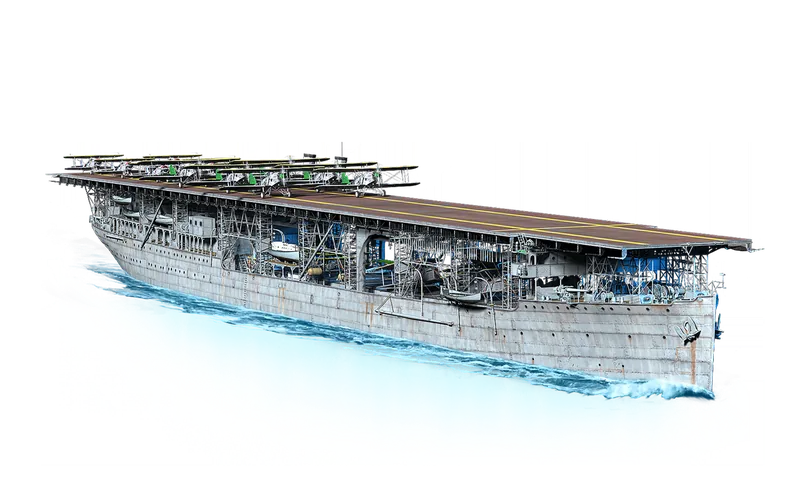
Hit PointsInitial: 33,300 → 33,700
Displacement15,150 t
Hull dimensions ƒ
Length x beam at the waterline, plus draft. Length matters when dodging torpedoes; beam and draft shape how hard the ship is to hit.
Armor range6–20 mm
Plate armor thicknesses6, 10, 13, 15, 19, 20 mm
Armor material/layer entries45
Fire resistance ƒ
stock hull: 1 − 0.9334 fire coefficient = 6.7%; top hull: 1 − 0.9001 fire coefficient = 10%. Lowers how often hits set you on fire. It does not reduce the damage a burning fire does per second; fires burn at the full rate on every ship.
Fire duration60 s
Fire damage ƒ
One unattended fire: 0.004 of max HP per second (0.4%) × 60 s = 0.24 of the pool; 0.24 × 33,700 HP = 8,088 HP on this ship. 4 fire points can burn at once.
Flood duration30 s
Flood damage ƒ
One unattended flood: 0.0025 of max HP per second (0.25%) × 30 s = 0.075 of the pool; 0.075 × 33,700 HP = 2,528 HP on this ship.
Torp Reduction ƒ
1 − 0.333 hull torpedo-damage coefficient / 0.333 unprotected baseline = 0%. Reduces torpedo hit damage. It does not affect flooding: floods start as often and tick at the full rate.
Steering gear HP ƒ
Durability of the steering gears. As this pool drops, hits are likelier to jam the rudder; unlike most modules the steering can be knocked out and repaired but is never permanently destroyed.
Repairable: penetration50%
Repairable: citadel10%
Repairable: steering gear50%
Bow section HP ƒ
Damage saturation pool for the bow: penetrations here deal their normal share until twice this much penetration damage has landed on the section (2 × 2,400 = 4,800), then further hits on it deal half damage. A penetration deals 0.33 × the shell's max damage; once the section is saturated it deals exactly half of that (0.5 × 0.33 = 0.165 × max damage), so a 3,000-damage shell's pen goes from 990 to 495. Overpens (0.1 × max damage) and citadels (1.0 ×) ignore saturation. Pens on the ship's other, unsaturated sections still deal the normal 0.33 ×. A larger pool keeps that part of the ship taking full damage for longer; a small one saturates fast and protects the ship's HP.
Casemate section HP ƒ
Damage saturation pool for the casemate: penetrations here deal their normal share until twice this much penetration damage has landed on the section (2 × 3,200 = 6,400), then further hits on it deal half damage. A penetration deals 0.33 × the shell's max damage; once the section is saturated it deals exactly half of that (0.5 × 0.33 = 0.165 × max damage), so a 3,000-damage shell's pen goes from 990 to 495. Overpens (0.1 × max damage) and citadels (1.0 ×) ignore saturation. Pens on the ship's other, unsaturated sections still deal the normal 0.33 ×. A larger pool keeps that part of the ship taking full damage for longer; a small one saturates fast and protects the ship's HP.
Auxiliary section HP ƒ
Damage saturation pool for the auxiliary room: penetrations here deal their normal share until twice this much penetration damage has landed on the section (2 × 3,600 = 7,200), then further hits on it deal half damage. A penetration deals 0.33 × the shell's max damage; once the section is saturated it deals exactly half of that (0.5 × 0.33 = 0.165 × max damage), so a 3,000-damage shell's pen goes from 990 to 495. Overpens (0.1 × max damage) and citadels (1.0 ×) ignore saturation. Pens on the ship's other, unsaturated sections still deal the normal 0.33 ×. A larger pool keeps that part of the ship taking full damage for longer; a small one saturates fast and protects the ship's HP.
Hull section HP ƒ
Damage saturation pool for the hull: penetrations here deal their normal share until twice this much penetration damage has landed on the section (2 × 25,300 = 50,600), then further hits on it deal half damage. A penetration deals 0.33 × the shell's max damage; once the section is saturated it deals exactly half of that (0.5 × 0.33 = 0.165 × max damage), so a 3,000-damage shell's pen goes from 990 to 495. Overpens (0.1 × max damage) and citadels (1.0 ×) ignore saturation. Pens on the ship's other, unsaturated sections still deal the normal 0.33 ×. A larger pool keeps that part of the ship taking full damage for longer; a small one saturates fast and protects the ship's HP.
Stern section HP ƒ
Damage saturation pool for the stern: penetrations here deal their normal share until twice this much penetration damage has landed on the section (2 × 900 = 1,800), then further hits on it deal half damage. A penetration deals 0.33 × the shell's max damage; once the section is saturated it deals exactly half of that (0.5 × 0.33 = 0.165 × max damage), so a 3,000-damage shell's pen goes from 990 to 495. Overpens (0.1 × max damage) and citadels (1.0 ×) ignore saturation. Pens on the ship's other, unsaturated sections still deal the normal 0.33 ×. A larger pool keeps that part of the ship taking full damage for longer; a small one saturates fast and protects the ship's HP.
Citadel section HP ƒ
This section has no practical saturation cap: every hit here keeps dealing its normal share of damage (on most ships the citadel; on many destroyers the casemate).
Total plane capacity24
Flight deck HP16,900
Hangar HP16,900
Plane HP1,500
Cruising speed103.0 kt
OrdnanceHE bomb, 4,000 alpha
Squadron size6 planes
Planes per drop2
Bombs per plane3
Bombs per drop ƒ
2 planes per drop x 3 bombs each = 6.
Alpha per drop ƒ
6 bombs x 4,000 alpha = 24,000, if every bomb hits. Before armor, saturation and the target's damage reduction; a real drop lands a share of it.
Fire chance24%
Bomb penetration42.7 mm
Hangar max12
Hangar restore+1 every 48 s, start 9
Recovery time48 s
Plane HP1,600
Cruising speed97.0 kt
Ordnancetorpedo, 4,900 alpha
Squadron size6 planes
Planes per drop2
Torpedoes per plane1
Torpedoes per drop ƒ
2 planes per drop x 1 torpedo each = 2.
Alpha per drop ƒ
2 torpedoes x 4,900 alpha = 9,800, if every torpedo hits. Before armor, saturation and the target's damage reduction; a real drop lands a share of it.
Flooding chance33%
Torpedo arming time3 s
Torpedo arming distance68 m
Hangar max12
Hangar restore+1 every 52 s, start 9
Recovery time52 s
Charges3
Duration60 s
Reload10 s
Charges2
Duration10 s
Reload150 s
Damage reduction-50%
EffectAll aircraft return to carrier.
AA mount pointsInitial: 0 → 20
Maximum AA range ƒ
Initial: 0 km → 3.5 km (stock → upgraded). Longest-reaching family on the in-game AA card. Base AirDefense aura max range is 0 km; dual-purpose mount auras extend it.
76.2 mm Mk22 mod. 24×1 76mm
12.7 mm Browning M2 mod. 116×1 13mm
Guns76.2 mm Mk22 mod. 2
Continuous DPS ƒ
Effective DPS: 9 raw aura damage × 3.5 × 1 hit probability = 32 - the same in-game units as the Close-range AA DPS headline.
Range3.5 km
Guns12.7 mm Browning M2 mod. 1
Continuous DPS ƒ
Effective DPS: 77 raw aura damage × 3.5 × 0.95 hit probability = 256 - the same in-game units as the Close-range AA DPS headline.
Range1.2 km
Total DPS in Aura ƒ
Far 32 + Near 256 = 288
AA explosions ƒ
Each ~2 s salvo fires 2 AA explosions in quick succession, each leaving 1 cloud ahead of the attacking squadron - up to 2 clouds per salvo × 110 damage each. Planes that fly into a cloud take its damage; clouds dissipate before the next salvo lands. Defensive AA Fire, where fitted, multiplies the AA explosions within each salvo, and commander skills that raise the Number of AA explosions add to it.
Cloud damage ƒ
Damage a plane takes for flying into one flak cloud, before any reductions.
Cloud spawn chance ƒ
Every potential cloud spawns - the full pattern, every salvo. Often called flak 'hit chance', but spawned clouds always damage planes that fly into them - the roll is on spawning.
Salvo interval ƒ
A new flak salvo (the AA explosions above) fires roughly every 2 s.
Fired by ƒ
Flak keeps firing while at least one AA mount is operational - it stops only once every AA mount is knocked out.
Flak zone ƒ
The activation band: flak fires while attacking planes are inside it. Clouds are placed ahead of the planes' path, so clouds can land short of 2.5 km or past 3.5 km - once planes get inside the band, new salvos stop. AA range bonuses push the outer edge out; the 2.5 km inner edge does not move.
Mounts4
Firing range3.5 km
Shell Grouping (σ)1
Secondary DPM (per side) ƒ
Sum across all secondary families of (per-side barrels × 60 / reload_s × alpha), with each reload counted in whole 1/7 s ticks (guns fire on the first tick after the reload), where per-side barrels = mounts × barrels-per-mount / 2 (the guns that bear on one broadside target). Per-family: 4×1 127 mm (2/side) × 60/7 s × 1800 = 30,857. Assumes every shell hits (real hit rate is lower; the Brawl matchup tool on the Compare page folds in dispersion + target armor).
Secondary fire DPM vs T3 BB (per side) ƒ
Fires/min (per side) 1 × (1 − 0.1 fire resistance) × 60 s × 0.003 of max HP per second × 40,500 HP = 6,748. Per side: the barrels that bear on one broadside target (mounts × barrels / 2). A ceiling: assumes every shell hits and ignores the four-fire cap and Fire Prevention.
Total secondary DPM vs T3 BB (per side) ƒ
Secondary DPM (per side) 30,857 + secondary fire DPM 6,748 = 37,606: shell damage plus fire damage against one T3 battleship, every shell hitting.
127 mm Mk74×1 127mm
Caliber127 mm
Reload time7 s
HE alpha1,800
Muzzle Velocity960 m/s
Fire Chance6%
Secondary fires/min (per side) ƒ
4×1 barrels / 2 sides × 60 / 7 s × 0.06 (6% fire chance) = 1. Per side: the barrels that bear on one broadside target (mounts × barrels / 2). A ceiling: assumes every shell hits and ignores the four-fire cap and Fire Prevention.
HE Pen21 mm
Secondary dispersion type ƒ
Max dispersion = range (km) × 57 + 30. Each dispersion type sets its own slope; this is not a percentage applied to a standard baseline.
Max secondary dispersion @ 3.5 km ƒ
3.5 km × 57 + 30 = 229.5 m.

Maneuverability
Engine power7,150 hp
Maximum speed18.0 kt
Turning circle radius730 m
Rudder shift timeInitial: 12.9 s → 9.2 s
Engine power-boost threshold7.0 kt
Engine spool-up time23 s
Reverse spool-up time11.5 s
Reverse speed ƒ
top speed / 4 + 4.9 = 18 / 4 + 4.9 = 9.4 kt. Base value; speed modifiers scale it.
Crash stop ƒ
Seconds from top speed to a dead stop after ordering full reverse: reverse power winds in over the reverse spool-up while water drag does most of the braking, using the ship's own reverse-power ratio. The full curve is on the acceleration chart. Full reverse stops about a quarter faster than a plain Stop order from top speed.
Engine boost threshold (reverse) ƒ
Speed below which the engine's built-in power boost applies in reverse.
Acceleration 0-90% ƒ
Time to reach 90% of top speed (16.2 kt of 18.0 kt).
Acceleration 0-99% ƒ
Time to reach 99% of top speed (17.8 kt of 18.0 kt). 99% rather than 100% because true top speed is asymptotic (thrust meets drag), so the last fraction of a knot is never quite gained.
Detectability by sea ƒ
Base value, no camouflage. With a Grade IV permanent camo (or any disposable camo): 10.74 km x 0.955 = 10.26 km. Camouflage does not change detectability by air.
With Grade IV camouflage (sea) ƒ
Detectability by sea 10.74 km x 0.955 (Grade IV permanent camo or any disposable camo) = 10.26 km.
Detectability by air7.52 km
Detect when firing (air) ƒ
Air detectability 7.52 km + gun-firing bloom 0 km = 7.52 km. The bloom tracks main-battery caliber x 0.020.
Detect when on fire (sea) ƒ
Sea detectability 10.74 km + 2.0 km while burning = 12.74 km.
Detect when on fire (air) ƒ
Air detectability 7.52 km + 3.0 km while burning = 10.52 km.
Guaranteed Detect2 km
 Automatic Damage Control Party∞ charges · 90 s reload · 60 s active
 Automatic Fighter4 charges · 40 s reload · 150 s active · 5 km patrol radius
ƒ
Derived from the consumable's 30 m grid-unit range (km = grid units x 30 / 1000):