World of Warships: Legends ship guide

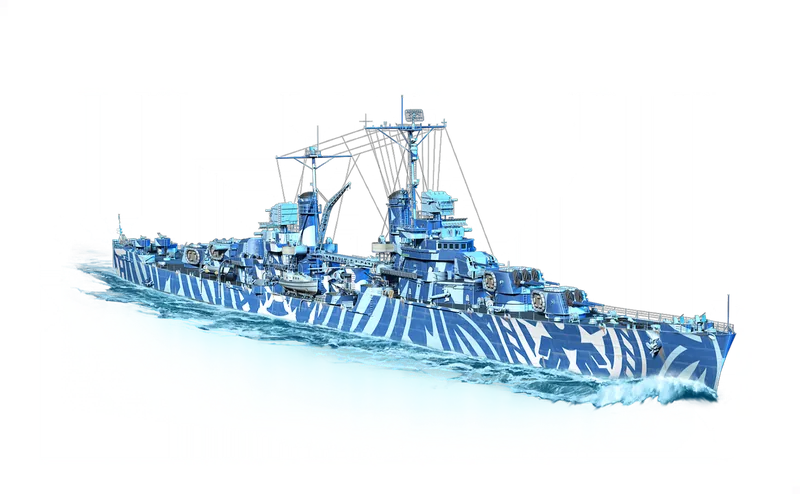
Dallas

Also called: 达拉斯 Beta
HE fire-spam cruiserAn HE damage-farmer with Sonar to clear islands and smoke before committing the hull.
Playstyle
  • Work the islands rather than a firing line
  • Avoid: Pushing in blind because the kit says brawler
Key characteristics
High HE / fire outputHigh AP DPMSonarDefensive AAThick stern plateSlow AP shells
On this page
Community Data

Dallas Community Stats

Across 20,000+ Standard battles from 400+ players, Dallas averages a 58% win rate, 41,100 damage and 0.9 kills per battle, and survives 35% of them.

Community Data

Dallas Community Stats

Log in to GamingDiver and upload your data to see Community Data for Dallas: community win rate, damage, survival, spotting, and your own comparison.

Log in & upload to see Community Data

Playstyle

Overview

Dallas is a Tier V American light cruiser whose 152mm guns bring 8.4 fires a minute (1st of 24), with Sonar as her vision tool: it lets her contest islands and smoke without exposing the hull. She carries no torpedoes, so everything has to come through the guns and the sonar bubble. Sonar reaches 4 km. Both shells run cohort-strong (top-decile AP at 224,000 AP DPM and top-decile HE at 154,000 HE DPM), making her a dual-threat gunship: keep AP up against broadsides and citadels, and switch to HE against bow-in ships, superstructures, and the thin or angled targets AP over-penetrates or bounces off. Standout traits: best AA reach in T5 CAs (5 km, 6th of 28) and best stern plate in T5 CAs (30 mm, 1st of 28). The trade is slow AP shells in T5 CAs (762, 28th of 28).

Positioning

Work the islands rather than a firing line. Sonar (4 km on ships, 2.8 km on torpedoes) is the whole kit, and it only pays inside that radius, so hold the cover beside a contested cap and use it to catch destroyers and torpedoes coming around the corner: HE into the destroyer, AP into any cruiser that shows you a broadside while it sits in smoke. Firing from a friendly smoke reveals you at 5.4 km, so pick the salvo rather than holding the trigger.

Potato Avoidance

Pushing in blind because the kit says brawler

4-km Sonar is what makes the close fight winnable, and it only helps once you are already committed; it does not tell you what is waiting two islands over. Push when a destroyer is lit or a teammate holds vision, not to find out who is there.

Signature Traits

ELITE MAIN BATTERY ↗
  • HE DPM machine · 154000 HE
  • AP DPM machine · 224000 AP
  • High fire pressure · 8.4 fires/min
Long-reach AA ↗

5 km AA reach, best of T5 CAs.

Thick stern plate ↗

30 mm stern, best of T5 CAs.

ELITE SECONDARIES ↗
  • Punchy HE · 1800 max
  • Punch-through secondaries · 21 mm
Slow AP shells ↗

762 m/s AP muzzle velocity, bottom decile of T5 CAs. Lobby trajectory, more lead, easier to dodge at range.

Few secondary fires ↗

1.5 secondary fires/min per side, bottom decile of T5 CAs. Less fire pressure from the secondaries than peers; the burn threat comes from the mains instead.

Acquisition

How to get Dallas

Dallas is available in the Fire-Starting Light Cruisers branch of the U.S. Tech Tree for 2,400,000 credits after researching it in the branch. Known module upgrades cost up to 480,000 credits. Container chances are shown as the listed odds of receiving this exact ship, dividing grouped ship-pool odds across the resolved ships and including nested container paths when a crate can drop another crate.

While you save up, check active promo codes for free doubloons, camouflages, and other rewards.

Show U.S.A. tech-tree branch diagram
U.S. Tech Tree

Dallas sits in the Fire-Starting Light Cruisers branch. The highlighted path shows the local branch context inside the full U.S. tree.

U.S. light cruisers are perfect for starting fires with hails of high-explosive shells thanks to their numerous rapid-firing guns, but they lack torpedoes entirely. Starting from Tier VII, they bring Radar and Sonar together to the battle to detect hidden enemy warships.
Advantages
High rate of fire, Long-duration Radar starting at Tier VII
Disadvantages
Low-velocity shells, Poor protection

Best listed chance for this ship

  • USN Cruisers Big Crate 9.51% V Dallas, VI Helena, or VI Boise* Archived · USN Cruisers Big Crate · 1 of 2 ships
Show direct source rows

Want the full picture? Each container page charts the odds as you open more crates - including pity guaranteed-reward timers and, for GD Supporters, pack math personalized to your port.

Builds

Pair with a commander whose unique skill complements her main armament; check the build tool for current recommendations.

Open in Build Tool →

Have a build you swear by? Open it in the Build Tool and hit Save build to share it here, or browse the Ship Builds guide for proven loadouts across the fleet.

Cohort position

Hide ▾

Where Dallas sits among Tier V CAs (27 ships). Notable standouts are shown first; the rest of the cohort-ranked stats are in the expand below. Acquisition variants (Black Friday, Founders Edition) are counted once with their base ship, not as separate peers.

BestFires per minute8.4 (1/24) BestAA range5 km (1 of 11 tied) BestStern armor30 mm (1/28) Top 10%HE DPM154,000 (2/24) Top 10%AP DPM224,000 (3/28) Top 10%Secondary HE alpha1,800 (3/25) Top 10%Secondary HE pen21 mm (3/25) Top 10%Effective HE DPM (incl. fire)217,262 (2/24) Top 25%Smoke fire bloom5.44 km (8/28) Top 25%Main dispersion131.3 m (7/28) Top 25%AA DPS277 (7/28) Top 25%AA threat902 (7/28) Top 25%Flak damage per salvo (expected)720 (5/26) Bottom 25%Main battery range14.24 km (23/28) Bottom 25%Secondary DPM (per side)54,000 (22/25) Bottom 25%Secondary fire chance5% (22/25) Bottom 25%HE velocity812 m/s (22/24) ShorterAP fuse timer0.01 s (25/28) Bottom 25%Max armor89 mm (24/28) WorstAP velocity762 m/s (28/28) WorstSecondary range4 km (1 of 8 tied) WorstNo torpedoes (4 of 28 in cohort)
See 25 mid-pack stats

Not standouts for Dallas -- here's where she sits on every other ranked stat in the cohort. Stats tagged NORM are tied across more than half the cohort, so the value is the cohort default rather than a standout.

Hit points28,300 HP(21/28) Max speed32.5 kt(17/28) Concealment11.59 km(14/28) Air detection6.95 km(13/28) Rudder shift8 s(19/28) Turning circle650 m(10/28) Main battery caliber152 mm(18/28) Main battery reload8.5 s(14/28) Sigma2(15/28) HE shell damage2,200(16/24) HE fire chance12%(15/24) AP shell damage3,200(21/28) Time to 90% speed23.9 s(15/28) Acceleration (0-12 kt)8.8 s(19/28) AP arming threshold25 mm(11/28) Engine power80,000 hp(18/28) Power / turn radius123.1 hp/m(15/28) Displacement9,700 t(10/28) Power-to-weight8.25 hp/t(16/28) AP pen at 10 km130 mm(18/28) Citadel belt89 mm(17/28) Bow armor16 mm(13/28) NormAP ricochet start45°(25 of 28 tied at this value) NormAP auto-bounce angle60°(25 of 28 tied at this value) NormTurn speed retained81%(25 of 28 tied at this value)
Survivability
Hit PointsInitial: 24,000 → 28,300
Displacement9,700 t
Hull dimensions
ƒLength x beam at the waterline, plus draft. Length matters when dodging torpedoes; beam and draft shape how hard the ship is to hit.
170.7 x 17.07 m
Armor range6–89 mm
Plate armor thicknesses6, 13, 16, 25, 30, 32, 37, 51, 64, 89 mm
Armor material/layer entries49
Fire resistance
ƒstock hull: 1 − 0.8002 fire coefficient = 20%; top hull: 1 − 0.7669 fire coefficient = 23.3%. Lowers how often hits set you on fire. It does not reduce the damage a burning fire does per second; fires burn at the full rate on every ship.
Initial: 20% → 23.3%
Fire duration30 s
Fire damage
ƒOne unattended fire: 0.003 of max HP per second (0.3%) × 30 s = 0.09 of the pool; 0.09 × 28,300 HP = 2,547 HP on this ship. 4 fire points can burn at once.
0.3% of HP per second
Flood duration40 s
Flood damage
ƒOne unattended flood: 0.0025 of max HP per second (0.25%) × 40 s = 0.1 of the pool; 0.1 × 28,300 HP = 2,830 HP on this ship.
0.25% of HP per second
Torp Reduction
ƒ1 − 0.32 hull torpedo-damage coefficient / 0.333 unprotected baseline = 4%. Reduces torpedo hit damage. It does not affect flooding: floods start as often and tick at the full rate.
4%
Magazine HP
ƒPer-turret powder-magazine HP, a separate pool from the ship's. Penetrating hits wear it down and the turret is likelier to be knocked out as it falls, so a larger pool keeps the guns firing through punishment that silences a peer's.
14,200
Steering gear HP
ƒDurability of the steering gears. As this pool drops, hits are likelier to jam the rudder; unlike most modules the steering can be knocked out and repaired but is never permanently destroyed.
8,500
Repairable: penetration50%
Repairable: citadel10%
Repairable: steering gear50%
Section HP
Bow section HP
ƒDamage saturation pool for the bow: penetrations here deal their normal share until twice this much penetration damage has landed on the section (2 × 2,100 = 4,200), then further hits on it deal half damage. A penetration deals 0.33 × the shell's max damage; once the section is saturated it deals exactly half of that (0.5 × 0.33 = 0.165 × max damage), so a 3,000-damage shell's pen goes from 990 to 495. Overpens (0.1 × max damage) and citadels (1.0 ×) ignore saturation. Pens on the ship's other, unsaturated sections still deal the normal 0.33 ×. A larger pool keeps that part of the ship taking full damage for longer; a small one saturates fast and protects the ship's HP.
2,100
Auxiliary section HP
ƒDamage saturation pool for the auxiliary room: penetrations here deal their normal share until twice this much penetration damage has landed on the section (2 × 3,800 = 7,600), then further hits on it deal half damage. A penetration deals 0.33 × the shell's max damage; once the section is saturated it deals exactly half of that (0.5 × 0.33 = 0.165 × max damage), so a 3,000-damage shell's pen goes from 990 to 495. Overpens (0.1 × max damage) and citadels (1.0 ×) ignore saturation. Pens on the ship's other, unsaturated sections still deal the normal 0.33 ×. A larger pool keeps that part of the ship taking full damage for longer; a small one saturates fast and protects the ship's HP.
3,800
Hull section HP
ƒDamage saturation pool for the hull: penetrations here deal their normal share until twice this much penetration damage has landed on the section (2 × 21,200 = 42,400), then further hits on it deal half damage. A penetration deals 0.33 × the shell's max damage; once the section is saturated it deals exactly half of that (0.5 × 0.33 = 0.165 × max damage), so a 3,000-damage shell's pen goes from 990 to 495. Overpens (0.1 × max damage) and citadels (1.0 ×) ignore saturation. Pens on the ship's other, unsaturated sections still deal the normal 0.33 ×. A larger pool keeps that part of the ship taking full damage for longer; a small one saturates fast and protects the ship's HP.
21,200
Superstructure section HP
ƒDamage saturation pool for the superstructure: penetrations here deal their normal share until twice this much penetration damage has landed on the section (2 × 900 = 1,800), then further hits on it deal half damage. A penetration deals 0.33 × the shell's max damage; once the section is saturated it deals exactly half of that (0.5 × 0.33 = 0.165 × max damage), so a 3,000-damage shell's pen goes from 990 to 495. Overpens (0.1 × max damage) and citadels (1.0 ×) ignore saturation. Pens on the ship's other, unsaturated sections still deal the normal 0.33 ×. The superstructure is not exempt: it saturates exactly like the bow and stern, so shells aimed at it stop dealing full damage once this pool is used up. A larger pool keeps that part of the ship taking full damage for longer; a small one saturates fast and protects the ship's HP.
900
Stern section HP
ƒDamage saturation pool for the stern: penetrations here deal their normal share until twice this much penetration damage has landed on the section (2 × 1,600 = 3,200), then further hits on it deal half damage. A penetration deals 0.33 × the shell's max damage; once the section is saturated it deals exactly half of that (0.5 × 0.33 = 0.165 × max damage), so a 3,000-damage shell's pen goes from 990 to 495. Overpens (0.1 × max damage) and citadels (1.0 ×) ignore saturation. Pens on the ship's other, unsaturated sections still deal the normal 0.33 ×. A larger pool keeps that part of the ship taking full damage for longer; a small one saturates fast and protects the ship's HP.
1,600
Citadel section HP
ƒThis section has no practical saturation cap: every hit here keeps dealing its normal share of damage (on most ships the citadel; on many destroyers the casemate).
No saturation cap
Main Battery
ModuleArtillery: 152 mm Mk16 Twin
Mounts / barrels4 mounts / 10 barrels
Reload timeInitial: 9.5 s → 8.5 s
Firing range (base)12.9 km
Firing range (top fire control)14.2 km
Turret traverseInitial: 8 °/s → 9 °/s
Turret armor75 mm
Turret traverse arcs
ƒHow far each mount can train, in degrees to either side of the mount's own facing. A rear turret with ±150° leaves a 60° blind wedge over the bow; one-sided arcs are wing mounts that cover a single side. The data does not say which way each mount faces, so the arcs are listed per mount without bow/stern angles.
4x ±150°
Guns to bear
ƒ180° − 150° (the most restricted aft-facing mount's arc) = 30° off bow; 180° − 150° (the most restricted forward-facing mount's arc) = 30° off stern. How far off the bow (or stern) the ship must angle before every main turret can fire: the widest blind wedge among the rear-facing (or forward-facing) mounts, from each mount's trainable arc.
30° off bow / 30° off stern
Shell Grouping (σ)2
Dispersion type
ƒIn practice: the baseline curve for a standard cruiser -- at max range (14.2 km) shells land in an ellipse about 131 m wide and 79 m tall. Also on this curve (215): AL Baltimore, AL Chapayev, AL Cheshire, AL Harbin, AL Montpelier, AL Tallinn, AL Zara, Aberdeen, Accord, Agano, Albemarle, Algérie and 203 more.
Standard cruiser
Max Horiz Disp
ƒHorizontal dispersion ellipse width at max range, from the dispersion model: σH=(R30·idealRadius−minRadiusidealDistance+minRadius)·30 =(1424530·8−1.11000+1.1)·30=131.3m
131.3 m at 14.2 km
Max Vert Disp
ƒVertical dispersion ellipse height at max range: σV=σH·radiusOnMax =131.3·0.6=78.8m
78.8 m at 14.2 km
Med Horiz Disp
ƒ50%-hit horizontal radius: σH,50=σH·0.6σ =131.3·0.62=39.4m
39.4 m at 14.2 km
Med Vert Disp
ƒ50%-hit vertical radius: σV,50=σV·0.6σ =78.8·0.62=23.6m
23.6 m at 14.2 km
Turret turn time
ƒ180 degrees / 8 deg/s traverse speed = 22.5 s.
22.5 s
Shells/min
ƒZero upgrades: 10 broadside guns x 60 / 9.571 s (9.5 s = 67 ticks) base reload = 62.7. All upgrades (top gun): 10 broadside guns x 60 / 8.571 s (8.5 s = 60 ticks) all-upgrades reload = 70.
Initial: 62.7 → 70
HE shells
HE alpha2,200
HE Velocity812 m/s
Fire Chance12%
HE fire DPM vs T5 BB63262
Effective HE DPM vs T5 BB217262
HE penetration
ƒ25 mm ≈ 152 mm caliber / 6 (standard HE penetration ratio).
25 mm
HE full-salvo alpha
ƒ2,200 HE damage x 10 broadside guns = 22,000.
22,000
HE DPM
ƒZero upgrades: 22,000 HE full-salvo alpha x 60 / 9.571 s (9.5 s = 67 ticks) base reload = 137,910. All upgrades (top gun): 22,000 HE full-salvo alpha x 60 / 8.571 s (8.5 s = 60 ticks) all-upgrades reload = 154,000.
Initial: 137,910 → 154,000
Fires/min
ƒZero upgrades: 62.7 shells/min × 0.12 (12% fire chance) = 7.52. All upgrades (top gun): 70 shells/min × 0.12 (12% fire chance) = 8.4.
Initial: 7.52 → 8.4
AP shells
AP alpha3,200
AP Velocity762 m/s
Min Ricochet45 deg
Guaranteed Ricochet60 deg
Fuse Timer0.01 s
Fuse Threshold25 mm
AP overmatch
ƒfloor(152 mm caliber / 14.3) = 10 mm (AP auto-penetrates plating this thick or less).
10 mm
AP Pen Close
ƒAP formula evaluated at muzzle velocity: P=10−7·K·m0.69·d−1.07·v01.38 =10−7·2445·590.69·0.152−1.07·7621.38=290.2mm.
290.2 mm point-blank
AP Pen Far
ƒSame formula at the ship's max firing range (14.2 km), where the shell has slowed to 352.2 m/s: P=10−7·2445·590.69·0.152−1.07·352.21.38=100mm.
100 mm at 14.2 km
AP full-salvo alpha
ƒ3,200 AP damage x 10 broadside guns = 32,000.
32,000
AP DPM
ƒZero upgrades: 32,000 AP full-salvo alpha x 60 / 9.571 s (9.5 s = 67 ticks) base reload = 200,597. All upgrades (top gun): 32,000 AP full-salvo alpha x 60 / 8.571 s (8.5 s = 60 ticks) all-upgrades reload = 224,000.
Initial: 200,597 → 224,000
AP AOE Radius
ƒAP shell over-penetration splash radius; scales with shell mass. Wickes 102mm = 3, standard 152mm CL ~ 20, Iowa 406mm ~ 270, Yamato 460mm = 400, Incomparable 650mm = 550 (max). Larger value = bigger splash damage area when AP over-pens.
15
AA Defense
AA mount points20
Maximum AA range
ƒLongest-reaching family on the in-game AA card. Base AirDefense aura max range is 3.1 km; dual-purpose mount auras extend it.
5 km
40 mm Bofors Mk1 (upgraded hull only)6×2 40mm
20 mm Oerlikon Mk4 (upgraded hull only)14×1 20mm
28 mm Mk2 mod. 2 (stock hull only)6×4 28mm
12.7 mm Browning M2 mod. 1 (stock hull only)14×1 13mm
127 mm Mk24 (DP)
ƒDual-purpose: your secondaries doing double duty against aircraft. The same mounts appear on the Secondary Battery card - shared guns, not extra hardware.
2×1 127mm
127 mm/38 Mk29 mod. 0 (DP)
ƒDual-purpose: your secondaries doing double duty against aircraft. The same mounts appear on the Secondary Battery card - shared guns, not extra hardware.
2×2 127mm
Far aura
Guns127 mm Mk24 (DP) + 127 mm/38 Mk29 mod. 0 (DP)
Continuous DPS
ƒEffective DPS in in-game units (raw aura damage × 3.5 × hit probability, summed per contributing aura) - matches the Close-range AA DPS headline's currency. Includes 57 from dual-purpose secondaries firing as AA in this range band.
57
Range5 km
Medium aura
Guns40 mm Bofors Mk1
Continuous DPS
ƒEffective DPS: 38 raw aura damage × 3.5 × 0.9 hit probability = 120 - the same in-game units as the Close-range AA DPS headline.
120
Range3.5 km
Total DPS in Aura
ƒFar 57 + Medium 120 = 177
177
Near aura
Guns20 mm Oerlikon Mk4
Continuous DPS
ƒEffective DPS: 34 raw aura damage × 3.5 × 0.85 hit probability = 101 - the same in-game units as the Close-range AA DPS headline.
101
Range2 km
Total DPS in Aura
ƒFar 57 + Medium 120 + Near 101 = 278
278
Flak
AA explosions
ƒEach ~2 s salvo fires 2 AA explosions in quick succession, each leaving 2 clouds ahead of the attacking squadron - up to 4 clouds per salvo × 200 damage each. Planes that fly into a cloud take its damage; clouds dissipate before the next salvo lands. Defensive AA Fire, where fitted, multiplies the AA explosions within each salvo, and commander skills that raise the Number of AA explosions add to it.
2 per salvo, 2 clouds each
Cloud damage
ƒDamage a plane takes for flying into one flak cloud, before any reductions.
200
Cloud spawn chance
ƒEach cloud in the pattern rolls this chance to spawn, so salvos average fewer clouds than the maximum. Often called flak 'hit chance', but spawned clouds always damage planes that fly into them - the roll is on spawning.
90%
Salvo interval
ƒA new flak salvo (the AA explosions above) fires roughly every 2 s.
every ~2 s
Fired by
ƒFlak keeps firing while at least one secondary battery mount is operational - even losing every dedicated AA mount does not stop it.
Secondary battery
Flak zone
ƒThe activation band: flak fires while attacking planes are inside it. Clouds are placed ahead of the planes' path, so clouds can land short of 2.5 km or past 5 km - once planes get inside the band, new salvos stop. AA range bonuses push the outer edge out; the 2.5 km inner edge does not move.
2.5-5 km
S
Secondary Battery
Mounts4
Firing range4.0 km
Shell Grouping (σ)1
Total secondary fires/min (per side)
ƒSum of each gun family's fires/min (per side): 0.5 + 1 = 1.5. Per side: the barrels that bear on one broadside target (mounts × barrels / 2). A ceiling: assumes every shell hits and ignores the four-fire cap and Fire Prevention.
1.5
Secondary DPM (per side)
ƒSum across all secondary families of (per-side barrels × 60 / reload_s × alpha), with each reload counted in whole 1/7 s ticks (guns fire on the first tick after the reload), where per-side barrels = mounts × barrels-per-mount / 2 (the guns that bear on one broadside target). Per-family: 2×1 127 mm (1/side) × 60/6 s × 1800 = 18,000 + 2×2 127 mm (2/side) × 60/6 s × 1800 = 36,000. Assumes every shell hits (real hit rate is lower; the Brawl matchup tool on the Compare page folds in dispersion + target armor).
54,000
Secondary fire DPM vs T5 BB (per side)
ƒFires/min (per side) 1.5 × (1 − 0.233 fire resistance) × 60 s × 0.003 of max HP per second × 54,550 HP = 11,297. Per side: the barrels that bear on one broadside target (mounts × barrels / 2). A ceiling: assumes every shell hits and ignores the four-fire cap and Fire Prevention.
11,297
Total secondary DPM vs T5 BB (per side)
ƒSecondary DPM (per side) 54,000 + secondary fire DPM 11,297 = 65,297: shell damage plus fire damage against one T5 battleship, every shell hitting.
65,297
Secondary dispersion type
ƒMax dispersion = range (km) × 57 + 30. Each dispersion type sets its own slope; this is not a percentage applied to a standard baseline.
Standard
Max secondary dispersion @ 4 km
ƒ4 km × 57 + 30 = 258 m.
258 m
127 mm Mk24 (2×1) (DP)
ƒDual-purpose: the same mounts also fire at aircraft, so they appear on the AA Defense card too - shared guns, not extra hardware.
Caliber127 mm
Reload time6 s
HE alpha1,800
Muzzle Velocity792 m/s
Fire Chance5%
Secondary fires/min (per side)
ƒ2×1 barrels / 2 sides × 60 / 6 s × 0.05 (5% fire chance) = 0.5. Per side: the barrels that bear on one broadside target (mounts × barrels / 2). A ceiling: assumes every shell hits and ignores the four-fire cap and Fire Prevention.
0.5
HE Pen21 mm
Show 1 more gun family
127 mm/38 Mk29 mod. 0 (2×2) (DP)
ƒDual-purpose: the same mounts also fire at aircraft, so they appear on the AA Defense card too - shared guns, not extra hardware.
Caliber127 mm
Reload time6 s
HE alpha1,800
Muzzle Velocity792 m/s
Fire Chance5%
Secondary fires/min (per side)
ƒ2×2 barrels / 2 sides × 60 / 6 s × 0.05 (5% fire chance) = 1. Per side: the barrels that bear on one broadside target (mounts × barrels / 2). A ceiling: assumes every shell hits and ignores the four-fire cap and Fire Prevention.
1
HE Pen21 mm
Maneuverability
Engine power80,000 hp
Maximum speed32.5 kt
Turning circle radius650 m
Rudder shift timeInitial: 11.2 s → 8 s
Engine power-boost threshold7.0 kt
Engine spool-up time15.3 s
Reverse spool-up time7.7 s
Reverse speed
ƒtop speed / 4 + 4.9 = 32.5 / 4 + 4.9 = 13.0 kt. Base value; speed modifiers scale it.
13.0 kt
Crash stop
ƒSeconds from top speed to a dead stop after ordering full reverse: reverse power winds in over the reverse spool-up while water drag does most of the braking, using the ship's own reverse-power ratio. The full curve is on the acceleration chart. Full reverse stops about a quarter faster than a plain Stop order from top speed.
26.6 s
Engine boost threshold (reverse)
ƒSpeed below which the engine's built-in power boost applies in reverse.
9.8 kt
Acceleration 0-90%
ƒTime to reach 90% of top speed (29.2 kt of 32.5 kt).
23.9 s
Acceleration 0-99%
ƒTime to reach 99% of top speed (32.2 kt of 32.5 kt). 99% rather than 100% because true top speed is asymptotic (thrust meets drag), so the last fraction of a knot is never quite gained.
38 s
Guns in a full turn
ƒWith the rudder hard over the hull turns 6.2°/s, so a target drifts across the bow at that rate. Turret traverse minus hull turn: 8 − 6.2 = +1.8°/s, so the guns hold the target through the turn. Main Battery Mod. 2 (+20% traverse) and Mod. 3 (−15%) move this line.
hold target (+1.8°/s spare)
Concealment
Detectability by sea
ƒBase value, no camouflage. With a Grade IV permanent camo (or any disposable camo): 11.59 km x 0.955 = 11.07 km. Camouflage does not change detectability by air.
11.59 km
With Grade IV camouflage (sea)
ƒDetectability by sea 11.59 km x 0.955 (Grade IV permanent camo or any disposable camo) = 11.07 km.
11.07 km
Detectability by air6.95 km
Smoke firing penalty5.44 km
Detect when firing (sea)
ƒmax(main battery range, sea detectability 11.59 km) = 14.25 km. Equal to the ship's main battery range (never below base detectability): firing makes you visible to everyone you can reach.
14.25 km
Detect when firing (air)
ƒAir detectability 6.95 km + gun-firing bloom 3.04 km = 9.99 km. The bloom tracks main-battery caliber 152 mm × 0.020 = 3.04 km.
9.99 km
Detect when on fire (sea)
ƒSea detectability 11.59 km + 2.0 km while burning = 13.59 km.
13.59 km
Detect when on fire (air)
ƒAir detectability 6.95 km + 3.0 km while burning = 9.95 km.
9.95 km
Guaranteed Detect2 km
✦
Consumables
Damage Control Party∞ charges · 60 s reload · 5 s active
Choose one

Sonar2 charges · 180 s reload · 92 s active · 3.96 km ship detect
ƒDerived from the consumable's 30 m grid-unit range (km = grid units x 30 / 1000): 132×301000=3.96 km
· 2.82 km torpedo detect
ƒDerived from the consumable's 30 m grid-unit range (km = grid units x 30 / 1000): 94×301000=2.82 km
Defensive AA Fire3 charges · 140 s reload · 25 s active · ×2 flak burst boost
ƒRepeats the flak burst pattern ×2 within each salvo - more clouds in the air over the salvo, at the same spots.

Catapult Fighter4 charges · 80 s reload · 70 s active · 5 km patrol radius
ƒDerived from the consumable's 30 m grid-unit range (km = grid units x 30 / 1000): 167×301000=5 km
· 1 squadron size
Module options (3)

Stats above use the fully-upgraded modules. These are the research-tree alternatives; trade-offs are flagged.

HullUpgrade
  • Hit points24,000 → 28,300
  • Rudder shift11.2 → 8 s
  • Close-range AA DPS62 → 72
  • Maximum AA range3.1 → 3.5 km
  • Turret traverse8 → 9 °/s
Fire controlUpgrade
  • Main battery range12,950 → 14,245 m
ArtilleryUpgrade
  • Base reload9.5 → 8.5 s

Under the hood

Show ▾

All values are ship base stats with modifications and upgrade changes denoted inline.

The constants behind the formulas and the long tail: shell and dispersion inputs, fixed-range anchors, salvo math, layered AA. Click the formula chip on any row to see how it is calculated.

Main battery formulas

vs standard cruiserStandard
The standard cruiser dispersion curve.
Shell scatter width @ 5 km67.5 m
(166.7 × (8 − 1.1) / 1000 + 1.1) × 30 = 67.5 m. Horizontal scatter at a fixed 5 km, from the same dispersion model as the rows below - a knife-fight-range anchor comparable across ships.
Shell scatter width @ 10 km102 m
(333.3 × (8 − 1.1) / 1000 + 1.1) × 30 = 102 m. How wide your shells scatter at 10 km, from the same dispersion model as the max-range figure above. Picking a fixed range makes this number directly comparable from ship to ship: max-range dispersion makes a longer-range gun look worse even when it's tighter at any common range. The interactive Dispersion tab on the Charts card plots the full curve from 0 to max range.
Shell scatter height @ 5 km27.7 m
How tall the scatter ellipse is at a fixed 5 km, from the same model, comparable from ship to ship. The height/width ratio is a piecewise-linear curve through three points from the ship's own dispersion data: radiusOnZero=0.2 at 0 m, radiusOnDelim=0.5 at delim·Rmax=0.5·14245=7122 m, and radiusOnMax=0.6 at 14245 m. Below the kink: k=0.2+(0.5−0.2)·50007122=0.4106, so σV=σH·k=67.5·0.4106=27.7m.
Shell scatter height @ 10 km55.1 m
How tall the same scatter ellipse is at 10 km. Comparable from ship to ship for the same reason as the width value above. The height/width ratio is a piecewise-linear curve through three points from the ship's own dispersion data: radiusOnZero=0.2 at 0 m, radiusOnDelim=0.5 at delim·Rmax=0.5·14245=7122 m, and radiusOnMax=0.6 at 14245 m. Above the kink: k=0.5+(0.6−0.5)·10000−712214245−7122=0.5404, so σV=σH·k=102·0.5404=55.1m.
AP pen 5 km191 mm
AP penetration at a fixed 5 km, from the same ballistic curve as AP Pen Close/Far: the shell's impact velocity at that range fed through the AP formula P=10−7·K·m0.69·d−1.07·v1.38 =10−7·2445·590.69·0.152−1.07·563.51.38=191mm, where 563.5 m/s is the shell's speed when it arrives at 5 km (from 762 m/s at the muzzle). Fixed anchors make ships directly comparable at the same fighting distance; the Charts card plots the full curve.
AP pen 10 km130 mm
AP penetration at a fixed 10 km, from the same ballistic curve as AP Pen Close/Far: the shell's impact velocity at that range fed through the AP formula P=10−7·K·m0.69·d−1.07·v1.38 =10−7·2445·590.69·0.152−1.07·425.21.38=130mm, where 425.2 m/s is the shell's speed when it arrives at 10 km (from 762 m/s at the muzzle). Fixed anchors make ships directly comparable at the same fighting distance; the Charts card plots the full curve.
AP flight time @ 10 km6.52 s
How long an AP shell takes to reach a target at a fixed 10 km, from the same numerically integrated trajectory the Charts card plots. The shell slows under quadratic air drag, adrag=kρv2, where ρ is air density from a standard-atmosphere profile and k bundles the shell's drag coefficient, caliber and mass: k=πCdd28m=π·0.322·0.15228·59=4.95×10⁻⁵. That runs from a 762 m/s muzzle velocity in 0.02 s steps under gravity 9.8 m/s² until the shell lands, then divides by 2.77 because the game clock runs faster than real time. Lower is better, since a faster shell is harder to dodge and needs less lead.
HE flight time @ 10 km6.77 s
How long an HE shell takes to reach a target at a fixed 10 km, from the same numerically integrated trajectory the Charts card plots. The shell slows under quadratic air drag, adrag=kρv2, where ρ is air density from a standard-atmosphere profile and k bundles the shell's drag coefficient, caliber and mass: k=πCdd28m=π·0.339·0.15228·47.6=6.46×10⁻⁵. That runs from a 812 m/s muzzle velocity in 0.02 s steps under gravity 9.8 m/s² until the shell lands, then divides by 2.77 because the game clock runs faster than real time. Lower is better, since a faster shell is harder to dodge and needs less lead.
Guns per full salvo (alpha, DPM)10
4 mounts × 2.5 barrels = 10; all 10 bear on the broadside.

Model inputs

Krupp (AP)2,445
Armor-penetration constant of the AP shell; penetration scales straight with it, so a 10% higher Krupp is 10% more penetration at every range.
AP shell mass59 kg
Enters penetration as mass^0.69 and slows the shell's drag deceleration, so a heavier shell keeps more velocity at range.
AP drag coefficient0.322
Air drag on the AP shell in flight; lower keeps velocity, and with it penetration, at long range.
AP muzzle velocity762 m/s
Starting speed of the AP shell; penetration scales with velocity^1.38.
HE muzzle velocity812 m/s
Starting speed of the HE shell; sets its flight time and lead.
idealRadius8
Horizontal dispersion growth per idealDistance of range, in 30 m units; the slope of the scatter-width line.
minRadius1.1
Horizontal dispersion at zero range, in 30 m units; the intercept of the scatter-width line.
idealDistance1,000 m
Range step over which horizontal dispersion grows by idealRadius.
taperDist4,000 m
Inside this range the scatter width tapers toward minRadius instead of following the line.
radiusOnZero0.2
Vertical scatter as a share of horizontal at zero range.
radiusOnDelim0.5
Vertical scatter as a share of horizontal at the delim point.
radiusOnMax0.6
Vertical scatter as a share of horizontal at maximum range.
delim0.5
Where the vertical-scatter curve bends, as a share of maximum range.

AA defense

AA DPS at max range56
Only families that reach 5 km contribute at the outer edge of the AA bubble. In-game families: 40mm Bofors Mk1 6x2 -> 120 DPS @ 3.5 km; 20mm Oerlikon MK4 14x1 -> 101 DPS @ 2 km; 5in38 Mk24 2x1 -> 28 DPS @ 5 km; 5in38 Mk29 Mod0 2x2 -> 28 DPS @ 5 km.
AA DPS layered by range56 DPS @ 5 km, 176 DPS @ 3.5 km, 277 DPS @ 2 km
@ 5 km: 28 + 28 = 56; @ 3.5 km: 120 + 28 + 28 = 176; @ 2 km: 120 + 101 + 28 + 28 = 277. Cumulative AA DPS at each family range threshold. Inner ranges stack the outer families, so a target closing the distance hits stronger AA bubbles as it crosses each band.
AA DPS at point-blank277
120 + 101 + 28 + 28 = 277 DPS: the sum of every family's average DPS, achievable only inside the closest-range family (2 km).
AA threat index902
120 × 3.5 + 101 × 2 + 28 × 5 + 28 × 5 = 902. SUM over AA auras of (aura DPS x aura range km). A plane crossing the AA bubble is exposed to each aura for a time proportional to that aura's range, so long-reach DPS is worth more than the same DPS in a short bubble. Units: DPS*km; used to rank overall AA threat across the cohort.
Near aura range2 km

Secondary battery firepower

Max HE alpha1800
max(1800 (127 mm), 1800 (127 mm)) = 1800. Maximum HE damage per shell across secondary HE families. Best on this ship: 1800 from the 127 mm family.
Max HE fire chance5%
max(5% (127 mm), 5% (127 mm)) = 5%. Maximum per-shell fire chance across secondary HE families (before target fire resistance is applied). Best on this ship: 5% from the 127 mm family.
Max HE pen21 mm
max(21 mm (127 mm), 21 mm (127 mm)) = 21 mm. Maximum HE armor penetration across secondary HE families (caliber × 1/6 for most nations; 1/4 for German/UK BBs). Shells whose pen falls under a plate's armor thickness shatter for 0 hull damage though fire chance still applies. Best on this ship: 21 mm from the 127 mm family.
Open in Charting Tool

Ship Charts

Background

A design version of a small light cruiser development which preceded the creation of Helena-class cruisers. She had features characteristic of most subsequent ships of this type in the U.S. Navy: moderate speed, the absence of torpedo armament, and the availability of dual-purpose guns complementing the 152 mm main battery mounted in turrets.

Armor Beta

Hull HP 24,000 → 28,300 with hull upgrade, distributed across 5 hull zones, each with its own plate thicknesses, saturation cap, and pen thresholds.

Bow & stern16 mm

Overmatched by 93+ AP guns across the bracket. Can’t reliably bow-tank; gets bow-citadelled and overpenned.

Belt / citadel89 mm

Thin belt: battleship AP citadels straight through it broadside. Rely on angle, speed and concealment, never sit flat.

Farming6 mm

Superstructure and extremities take HE pens and AP overpens from nearly any gun: steady chip damage. Fire resistance 23%, fires burn 30s. Range-by-range in the Compare tool →

Section Plates HP cap Threats Tactic
Bow16 mm primary (range 16–37 mm)2,100 (7% of HP)
Overmatched by 283mm+ AP (Moltke, Graf Spee)Angle bounces 203mm16 mm: HE pens from 127mm+
Bow-tank fits behind this exterior plate. Saturation is FAST here; the cap is often only a few thousand HP.
Hull (midship)13 mm primary (range 13–89 mm)21,200 (75% of HP)
Overmatched by 203mm+ AP (Desert Falcon, Baleares)Angle bounces 152mm13 mm: HE pens from 127mm+
Largest HP pool. Citadel sits behind these plates; thinner deck and side plating absorb the rest.
Stern30 mm primary (range 16–30 mm)1,600 (6% of HP)
Overmatch not possible in its bracketAngle bounces 410mm30 mm: HE pens from 203mm+
Mirror of bow. Same fast saturation.
Citadel89 mm primary (range 16–89 mm)≈ 165,500 (effectively no cap)
Citadel pen: full damageOver-pen: ×0.10 damage
Effectively no cap; citadel pool sits at ~165k HP on every ship. An AP citadel penetration deals the shell's full damage, the biggest single hit available; only over-penetrations are damped, to ×0.10.
Superstructure6 mm primary (range 6–64 mm)900 (3% of HP)
Any HE ≥16 mm pens at full damage
Any HE ≥16 mm pens at full damage. HE-spam target, and the section saturates fast (often only a few thousand HP).
Turret (module, per magazine)separate HP pool, does not drain ship HP14,200 magazine HPTurret knocked outPer-turret powder-magazine HP, a separate pool that does not drain ship HP. As it is worn down the turret is likelier to be knocked out, and a smaller pool gets there faster.
Secondary mount (127 mm mount)separate HP pool, does not drain ship HP800 per-mount HPDestroyed at 0 HPPer-mount HP for the heaviest secondary on this ship. A mount destroyed at 0 HP is out for the rest of the battle; DCP does not repair destroyed mounts. Smaller (lighter-caliber) secondaries typically share the same HP value.
AA mount (40 mm mount)separate HP pool, does not drain ship HP200 per-mount HPDestroyed at 0 HPPer-mount HP for the heaviest AA on this ship. An AA mount destroyed at 0 HP stops shooting down planes for the rest of the battle; DCP does not repair destroyed mounts. HE shells specifically target AA mounts since the small-caliber HP pool falls fast.
Rudder (module)separate HP pool, does not drain ship HP8,500 module HPIncapacitated at 0 HPWhen module HP reaches 0 the rudder locks at its current angle until DCP repairs it. Repair via Damage Control Party.

Saturation cap = HP a section can absorb before further damage to it is reduced (the "bow-tank" effect). Citadel pool is ~165k on every ship (effectively no cap); damage is gated by pen/over-pen multipliers instead. Superstructure saturates fast but HE always pens regardless of the plate thickness. Rudder (and other module HPs) are a separate pool from ship HP: damaging a module doesn't drain ship HP. Incapacitated modules like the rudder and engine are restored by DCP, but secondary and AA mounts destroyed at 0 HP stay out for the rest of the battle.

Balance History

Balance updates affecting Dallas. Cards are condensed; use each source link for full context.

Nerf ×3Buff ×2Main Battery ×5
2024-04-25

Ministry of Balance: Old Gold

  • Dallas is a sleeping monster at Tier V, so we're reducing her damage output. We're also taking this opportunity to make the ship's progression simpler, with direct upgrades for artillery.
  • Stock main battery reload speed increased from 8.5 to 9.5 seconds.
  • Upgraded main battery reload speed increased from 7.5 to 8.5 seconds.
  • Removed "side-grade" change of shells from the artillery upgrade:
  • Upgraded main battery AP shell damage increased from 3,000 to 3,200.
  • Upgraded main battery HE shell damage increased from 2,100 to 2,200.
Read the full official post
Exteriors

Skins & permanent camouflages

Every custom exterior Dallas can equip.

Primary official WG sources

Filtered to official World of Warships: Legends pages where this ship is a focus, reward, line member, or high-context variant mention.