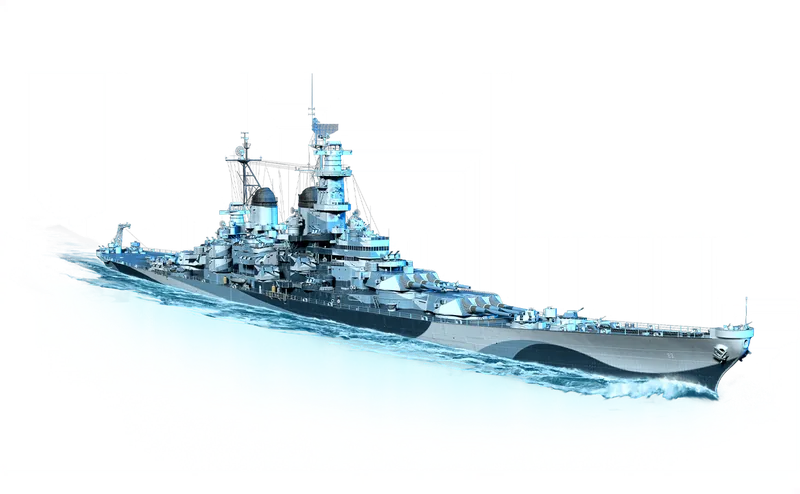
Hit Points65,000
Displacement50,000 t
Hull dimensions ƒ
Length x beam at the waterline, plus draft. Length matters when dodging torpedoes; beam and draft shape how hard the ship is to hit.
Armor range6–439 mm
Plate armor thicknesses6, 16, 19, 25, 32, 38, 50, 51, 76, 127, 142, 152, 157, 163, 181, 184, 287, 297, 307, 343, 368, 439 mm
Armor material/layer entries61
Fire resistance ƒ
top hull: 1 − 0.6337 fire coefficient = 36.6%. Lowers how often hits set you on fire. It does not reduce the damage a burning fire does per second; fires burn at the full rate on every ship.
Fire duration60 s
Fire damage ƒ
One unattended fire: 0.003 of max HP per second (0.3%) × 60 s = 0.18 of the pool; 0.18 × 65,000 HP = 11,700 HP on this ship. 4 fire points can burn at once.
Flood duration40 s
Flood damage ƒ
One unattended flood: 0.005 of max HP per second (0.5%) × 40 s = 0.2 of the pool; 0.2 × 65,000 HP = 13,000 HP on this ship.
Torp Reduction ƒ
1 − 0.25 hull torpedo-damage coefficient / 0.333 unprotected baseline = 25%. Reduces torpedo hit damage. It does not affect flooding: floods start as often and tick at the full rate.
Magazine HP ƒ
Per-turret powder-magazine HP, a separate pool from the ship's. Penetrating hits wear it down and the turret is likelier to be knocked out as it falls, so a larger pool keeps the guns firing through punishment that silences a peer's.
Steering gear HP ƒ
Durability of the steering gears. As this pool drops, hits are likelier to jam the rudder; unlike most modules the steering can be knocked out and repaired but is never permanently destroyed.
Effective HP ƒ
Base 65,000 HP plus everything Repair Party can restore: 0.005 of max HP per second (0.5%) × 28 s × 65,000 HP = 9,100 HP per charge, × 3 charges = 27,300 HP. Ceiling, not a prediction: a charge only restores damage actually taken, and only the regeneratable share of it. In practice ships realize about half of this, mostly because half the charges go unspent; a charge that is used returns about 97% of the per-charge figure above.
Repairable: penetration50%
Repairable: citadel10%
Repairable: steering gear50%
Bow section HP ƒ
Damage saturation pool for the bow: penetrations here deal their normal share until twice this much penetration damage has landed on the section (2 × 3,300 = 6,600), then further hits on it deal half damage. A penetration deals 0.33 × the shell's max damage; once the section is saturated it deals exactly half of that (0.5 × 0.33 = 0.165 × max damage), so a 3,000-damage shell's pen goes from 990 to 495. Overpens (0.1 × max damage) and citadels (1.0 ×) ignore saturation. Pens on the ship's other, unsaturated sections still deal the normal 0.33 ×. A larger pool keeps that part of the ship taking full damage for longer; a small one saturates fast and protects the ship's HP.
Casemate section HP ƒ
Damage saturation pool for the casemate: penetrations here deal their normal share until twice this much penetration damage has landed on the section (2 × 8,100 = 16,200), then further hits on it deal half damage. A penetration deals 0.33 × the shell's max damage; once the section is saturated it deals exactly half of that (0.5 × 0.33 = 0.165 × max damage), so a 3,000-damage shell's pen goes from 990 to 495. Overpens (0.1 × max damage) and citadels (1.0 ×) ignore saturation. Pens on the ship's other, unsaturated sections still deal the normal 0.33 ×. A larger pool keeps that part of the ship taking full damage for longer; a small one saturates fast and protects the ship's HP.
Hull section HP ƒ
Damage saturation pool for the hull: penetrations here deal their normal share until twice this much penetration damage has landed on the section (2 × 52,000 = 104,000), then further hits on it deal half damage. A penetration deals 0.33 × the shell's max damage; once the section is saturated it deals exactly half of that (0.5 × 0.33 = 0.165 × max damage), so a 3,000-damage shell's pen goes from 990 to 495. Overpens (0.1 × max damage) and citadels (1.0 ×) ignore saturation. Pens on the ship's other, unsaturated sections still deal the normal 0.33 ×. A larger pool keeps that part of the ship taking full damage for longer; a small one saturates fast and protects the ship's HP.
Superstructure section HP ƒ
Damage saturation pool for the superstructure: penetrations here deal their normal share until twice this much penetration damage has landed on the section (2 × 4,400 = 8,800), then further hits on it deal half damage. A penetration deals 0.33 × the shell's max damage; once the section is saturated it deals exactly half of that (0.5 × 0.33 = 0.165 × max damage), so a 3,000-damage shell's pen goes from 990 to 495. Overpens (0.1 × max damage) and citadels (1.0 ×) ignore saturation. Pens on the ship's other, unsaturated sections still deal the normal 0.33 ×. The superstructure is not exempt: it saturates exactly like the bow and stern, so shells aimed at it stop dealing full damage once this pool is used up. A larger pool keeps that part of the ship taking full damage for longer; a small one saturates fast and protects the ship's HP.
Stern section HP ƒ
Damage saturation pool for the stern: penetrations here deal their normal share until twice this much penetration damage has landed on the section (2 × 4,000 = 8,000), then further hits on it deal half damage. A penetration deals 0.33 × the shell's max damage; once the section is saturated it deals exactly half of that (0.5 × 0.33 = 0.165 × max damage), so a 3,000-damage shell's pen goes from 990 to 495. Overpens (0.1 × max damage) and citadels (1.0 ×) ignore saturation. Pens on the ship's other, unsaturated sections still deal the normal 0.33 ×. A larger pool keeps that part of the ship taking full damage for longer; a small one saturates fast and protects the ship's HP.
Citadel section HP ƒ
This section has no practical saturation cap: every hit here keeps dealing its normal share of damage (on most ships the citadel; on many destroyers the casemate).
ModuleArtillery: 406 mm Mk7
Mounts / barrels3 mounts / 9 barrels
Reload time30 s
Firing range17.4 km
Turret traverse4 °/s
Turret armor432 mm
Turret traverse arcs ƒ
How far each mount can train, in degrees to either side of the mount's own facing. A rear turret with ±150° leaves a 60° blind wedge over the bow; one-sided arcs are wing mounts that cover a single side. The data does not say which way each mount faces, so the arcs are listed per mount without bow/stern angles.
Guns to bear ƒ
180° − 149° (the most restricted aft-facing mount's arc) = 31° off bow; 180° − 142° (the most restricted forward-facing mount's arc) = 38° off stern. How far off the bow (or stern) the ship must angle before every main turret can fire: the widest blind wedge among the rear-facing (or forward-facing) mounts, from each mount's trainable arc.
Shell Grouping (σ)1.8
Dispersion type ƒ
In practice: the baseline curve for a standard battleship -- at max range (17.4 km) shells land in an ellipse about 234 m wide and 140 m tall. Also on this curve (68): AL New Jersey, Agincourt, Alabama, Alabama B, Arizona, Arkansas, Arkansas FE, Atlântico, BA Montana, Bellerophon, Bourgogne, California and 56 more.
Max Horiz Disp ƒ
Horizontal dispersion ellipse width at max range, from the dispersion model:
Max Vert Disp ƒ
Vertical dispersion ellipse height at max range:
Med Horiz Disp ƒ
50%-hit horizontal radius:
Med Vert Disp ƒ
50%-hit vertical radius:
Turret turn time ƒ
180 degrees / 4 deg/s traverse speed = 45 s.
Shells/min ƒ
Zero upgrades: 9 broadside guns x 60 / 30 s base reload = 18. All upgrades (Main Battery Mod. 3 = -10% reload): 9 broadside guns x 60 / 27 s all-upgrades reload (30 s × 0.9 Main Battery Mod. 3 = 27 s) = 20.
HE shells
HE alpha5,700
HE Velocity820 m/s
Fire Chance36%
HE fire DPM vs T7 BB48067
Effective HE DPM vs T7 BB150667
HE penetration ƒ
68 mm ≈ 406 mm caliber / 6 (standard HE penetration ratio).
HE full-salvo alpha ƒ
5,700 HE damage x 9 broadside guns = 51,300.
HE DPM ƒ
Zero upgrades: 51,300 HE full-salvo alpha x 60 / 30 s base reload = 102,600. All upgrades (Main Battery Mod. 3 = -10% reload): 51,300 HE full-salvo alpha x 60 / 27 s all-upgrades reload (30 s × 0.9 Main Battery Mod. 3 = 27 s) = 114,000.
Fires/min ƒ
Zero upgrades: 18 shells/min × 0.36 (36% fire chance) = 6.48. All upgrades (Main Battery Mod. 3 = -10% reload): 20 shells/min × 0.36 (36% fire chance) = 7.2.
AP shells
AP alpha13,500
AP Velocity762 m/s
Min Ricochet45 deg
Guaranteed Ricochet60 deg
Fuse Timer0.033 s
Fuse Threshold68 mm
AP pen max range514 mm
AP overmatch ƒ
floor(406 mm caliber / 14.3) = 28 mm (AP auto-penetrates plating this thick or less).
AP Pen Close ƒ
AP formula evaluated at muzzle velocity: .
AP Pen Far ƒ
Same formula at the ship's max firing range (17.4 km), where the shell has slowed to 529.9 m/s: .
AP full-salvo alpha ƒ
13,500 AP damage x 9 broadside guns = 121,500.
AP DPM ƒ
Zero upgrades: 121,500 AP full-salvo alpha x 60 / 30 s base reload = 243,000. All upgrades (Main Battery Mod. 3 = -10% reload): 121,500 AP full-salvo alpha x 60 / 27 s all-upgrades reload (30 s × 0.9 Main Battery Mod. 3 = 27 s) = 270,000.
AP AOE Radius ƒ
AP shell over-penetration splash radius; scales with shell mass. Wickes 102mm = 3, standard 152mm CL ~ 20, Iowa 406mm ~ 270, Yamato 460mm = 400, Incomparable 650mm = 550 (max). Larger value = bigger splash damage area when AP over-pens.
AA mount points49
Maximum AA range ƒ
Longest-reaching family on the in-game AA card. Base AirDefense aura max range is 3.5 km; dual-purpose mount auras extend it.
40 mm Bofors Mk22×4 40mm
40 mm Bofors Mk218×4 40mm
20 mm Oerlikon Mk2029×2 20mm
127 mm Mk32 (DP) ƒ
Dual-purpose: your secondaries doing double duty against aircraft. The same mounts appear on the Secondary Battery card - shared guns, not extra hardware.
Guns127 mm Mk32 (DP)
Continuous DPS ƒ
Effective DPS in in-game units (raw aura damage × 3.5 × hit probability, summed per contributing aura) - matches the Close-range AA DPS headline's currency. Includes 129 from dual-purpose secondaries firing as AA in this range band.
Range5 km
Guns40 mm Bofors Mk2
Continuous DPS ƒ
Effective DPS: 146 raw aura damage × 3.5 × 0.75 hit probability = 383 - the same in-game units as the Close-range AA DPS headline.
Range3.5 km
Total DPS in Aura ƒ
Far 129 + Medium 383 = 512
Guns20 mm Oerlikon Mk20
Continuous DPS ƒ
Effective DPS: 98 raw aura damage × 3.5 × 0.7 hit probability = 240 - the same in-game units as the Close-range AA DPS headline.
Range2 km
Total DPS in Aura ƒ
Far 129 + Medium 383 + Near 240 = 752
AA explosions ƒ
Each ~2 s salvo fires 2 AA explosions in quick succession, each leaving 4 clouds ahead of the attacking squadron, plus 2 stray clouds farther out that appear off-beat between salvos - up to 10 clouds per salvo × 230 damage each. Planes that fly into a cloud take its damage; clouds dissipate before the next salvo lands. Defensive AA Fire, where fitted, multiplies the AA explosions within each salvo, and commander skills that raise the Number of AA explosions add to it.
Cloud damage ƒ
Damage a plane takes for flying into one flak cloud, before any reductions.
Cloud spawn chance ƒ
Each cloud in the pattern rolls this chance to spawn, so salvos average fewer clouds than the maximum. Often called flak 'hit chance', but spawned clouds always damage planes that fly into them - the roll is on spawning.
Salvo interval ƒ
A new flak salvo (the AA explosions above) fires roughly every 2 s.
Fired by ƒ
Flak keeps firing while at least one secondary battery mount is operational - even losing every dedicated AA mount does not stop it.
Flak zone ƒ
The activation band: flak fires while attacking planes are inside it. Clouds are placed ahead of the planes' path, so clouds can land short of 2.5 km or past 5 km - once planes get inside the band, new salvos stop. AA range bonuses push the outer edge out; the 2.5 km inner edge does not move.
Mounts10
Firing range5.0 km
Shell Grouping (σ)1
Secondary DPM (per side) ƒ
Sum across all secondary families of (per-side barrels × 60 / reload_s × alpha), with each reload counted in whole 1/7 s ticks (guns fire on the first tick after the reload), where per-side barrels = mounts × barrels-per-mount / 2 (the guns that bear on one broadside target). Per-family: 10×2 127 mm (10/side) × 60/6 s × 1800 = 180,000. Assumes every shell hits (real hit rate is lower; the Brawl matchup tool on the Compare page folds in dispersion + target armor).
Secondary fire DPM vs T7 BB (per side) ƒ
Fires/min (per side) 5 × (1 − 0.366 fire resistance) × 60 s × 0.003 of max HP per second × 65,000 HP = 37,089. Per side: the barrels that bear on one broadside target (mounts × barrels / 2). A ceiling: assumes every shell hits and ignores the four-fire cap and Fire Prevention.
Total secondary DPM vs T7 BB (per side) ƒ
Secondary DPM (per side) 180,000 + secondary fire DPM 37,089 = 217,089: shell damage plus fire damage against one T7 battleship, every shell hitting.
127 mm Mk32 (DP) ƒ
Dual-purpose: the same mounts also fire at aircraft, so they appear on the AA Defense card too - shared guns, not extra hardware.
Caliber127 mm
Reload time6 s
HE alpha1,800
Muzzle Velocity792 m/s
Fire Chance5%
Secondary fires/min (per side) ƒ
10×2 barrels / 2 sides × 60 / 6 s × 0.05 (5% fire chance) = 5. Per side: the barrels that bear on one broadside target (mounts × barrels / 2). A ceiling: assumes every shell hits and ignores the four-fire cap and Fire Prevention.
HE Pen21 mm
Secondary dispersion type ƒ
Max dispersion = range (km) × 57 + 30. Each dispersion type sets its own slope; this is not a percentage applied to a standard baseline.
Max secondary dispersion @ 5 km ƒ
5 km × 57 + 30 = 315 m.

Maneuverability
Engine power212,000 hp
Maximum speed30.0 kt
Turning circle radius920 m
Rudder shift time19.5 s
Engine power-boost threshold7.0 kt
Engine spool-up time23 s
Reverse spool-up time11.5 s
Reverse speed ƒ
top speed / 4 + 4.9 = 30 / 4 + 4.9 = 12.4 kt. Base value; speed modifiers scale it.
Crash stop ƒ
Seconds from top speed to a dead stop after ordering full reverse: reverse power winds in over the reverse spool-up while water drag does most of the braking, using the ship's own reverse-power ratio. The full curve is on the acceleration chart. Full reverse stops about a quarter faster than a plain Stop order from top speed.
Engine boost threshold (reverse) ƒ
Speed below which the engine's built-in power boost applies in reverse.
Acceleration 0-90% ƒ
Time to reach 90% of top speed (27.0 kt of 30.0 kt).
Acceleration 0-99% ƒ
Time to reach 99% of top speed (29.7 kt of 30.0 kt). 99% rather than 100% because true top speed is asymptotic (thrust meets drag), so the last fraction of a knot is never quite gained.
Guns in a full turn ƒ
With the rudder hard over the hull turns 3.3°/s, so a target drifts across the bow at that rate. Turret traverse minus hull turn: 4 − 3.3 = +0.7°/s, so the guns hold the target through the turn. Main Battery Mod. 2 (+20% traverse) and Mod. 3 (−15%) move this line.
Detectability by sea ƒ
Base value, no camouflage. With a Grade IV permanent camo (or any disposable camo): 15.41 km x 0.955 = 14.72 km. Camouflage does not change detectability by air.
With Grade IV camouflage (sea) ƒ
Detectability by sea 15.41 km x 0.955 (Grade IV permanent camo or any disposable camo) = 14.72 km.
Detectability by air12.33 km
Smoke firing penalty14.86 km
Detect when firing (sea) ƒ
max(main battery range, sea detectability 15.41 km) = 17.38 km. Equal to the ship's main battery range (never below base detectability): firing makes you visible to everyone you can reach.
Detect when firing (air) ƒ
Air detectability 12.33 km + gun-firing bloom 8.12 km = 20.45 km. The bloom tracks main-battery caliber 406 mm × 0.020 = 8.12 km.
Detect when on fire (sea) ƒ
Sea detectability 15.41 km + 2.0 km while burning = 17.41 km.
Detect when on fire (air) ƒ
Air detectability 12.33 km + 3.0 km while burning = 15.33 km.
Guaranteed Detect2 km
 Damage Control Party∞ charges · 80 s reload · 20 s active
 Repair Party3 charges · 80 s reload · 28 s active · 9,100 HP (14% of max HP) total heal (per charge)
ƒ
0.005 of max HP per second (0.5%) × 28 s effective active time = 0.14 of max HP × 65,000 HP = 9,100 HP: up to 14% of max HP restored per charge.ƒ
0.14 of max HP per charge × 3 charges = 0.42 × 65,000 HP = 27,300 HP: up to 42% of max HP if the whole Repair Party loadout is used.ƒ
0.005 (0.5% of max HP) × 65,000 HP = 325 HP/s. WoWS heals a flat percent of MAX HP each second, so this rate holds at any health level.Choose one
 Surveillance Radar2 charges · 180 s reload · 35 s active · 9.5 km radar range
ƒ
Derived from the consumable's 30 m grid-unit range (km = grid units x 30 / 1000):  Enhanced Secondary Targeting3 charges · 160 s reload · 30 s active · +100% grouping · -50% dispersion